
Thomas Pynchon's Shadow Ticket

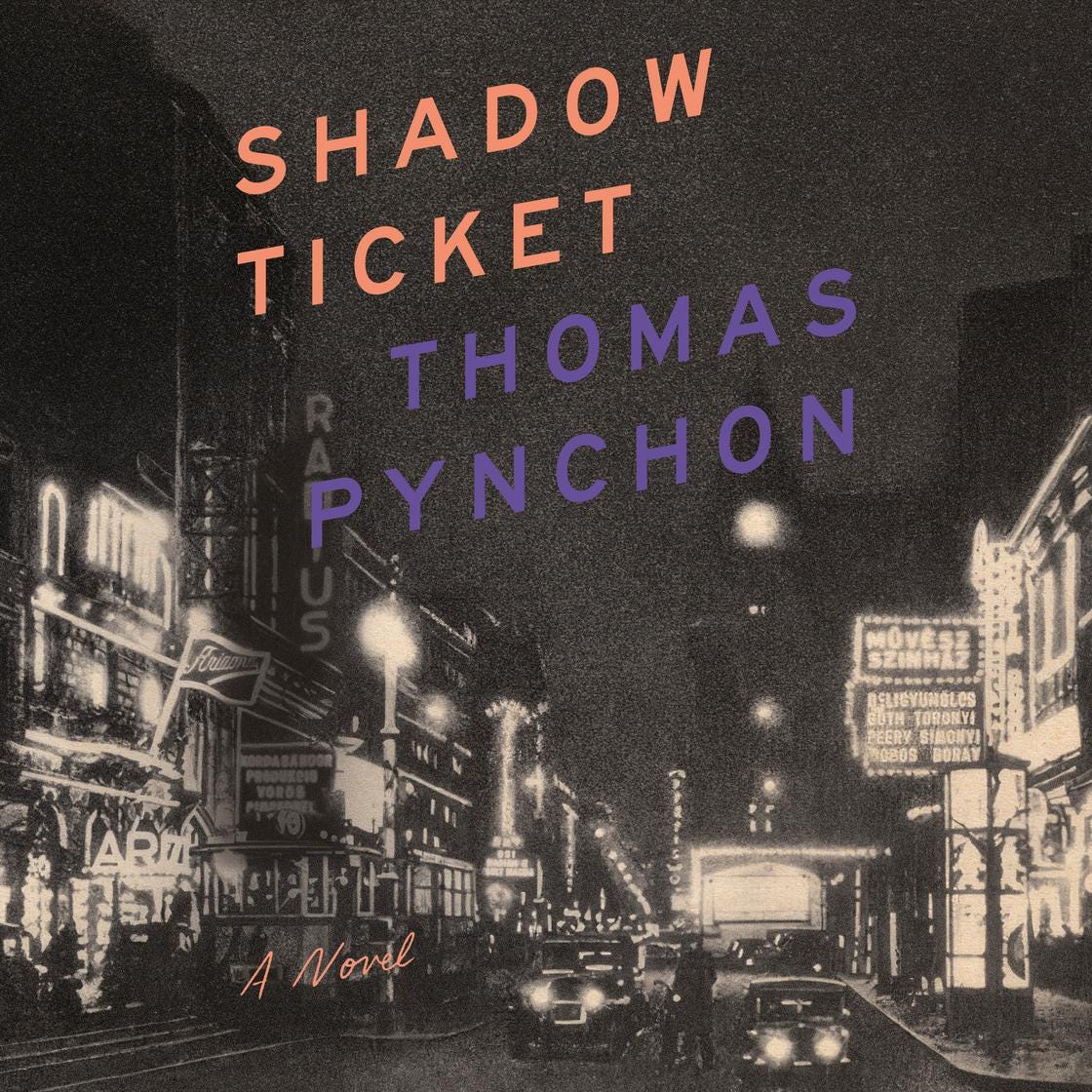
Before I even got my hands on it, the early-strike critical consensus was telling us the GOAT of PoMo had dialed it in. In particular, a wannabe viral kill-shot from the New Yorker’s take tried to wax badass in the face of readers-in-general’s expectations:
“If our reigning artist of paranoid convictions, of high crimes and deep states, of the peculiar combination of depravity and absurdity found in those who lust for power—if that guy hasn’t made use of the present political moment to craft a satire or a survival manual or a swan song or even an “I told you so,” then what has he come here, after a long silence and in all likelihood for the last time, to tell us?”
Sounded a bit to me at the time that someone had been reading Pynchon via PTA, and on top of that, who gave this gal the carte blanche to cry for more immersive satisfaction from what she assumes should be the near-90 y/o’s last work? How high on your own supply need one be to cry for a “survival manual” from any artist, much less one who’d made his hay on performing at multiple levels at once?
The call from inside the house for more synthesis, more culmination, from the career arc of an artist publicly defined as much by his refusal to appear as the polyphony of his thick-spined multisyllabic run-on production mode, appears to me less so critical than prescriptive—how dare we leave us here with our pants down only partly pretending we had any idea what he’d been getting up to all this time—which of course has become essentially status quo for a media hype train model already on its last legs under the weight of know-it-alls who imagine the masthead they appear on equals participation in the literary conversation by dint.
For those to whom each new release is nothing more than a subject for a hyperlink conversation piece, the conceit of literature being ‘for all of us’ would seem to them a human right—how dare anybody, much less the Wizard of Oz of stumbling blocks, not consider the audience above all else, and therefore also his own oeuvre, which according to the same class of critic belongs to us (meaning the royal most critics adopt along with their credentials), not the artist, and definitely definitely not the artist who makes his own market full cloth by putting the art over the visible evidence of its digestion.
I think a lot about DFW’s comment, shortly after the release of Infinite Jest to immense and immediate praise, in which he pointed out that it only takes basic math to realize that no one could have read and processed a 1100 page novel with footnotes in time to unpack it in such short time as the press window requires; therefore, in his mind, all the positive responses were essentially dubious, if not entirely window dressing.
In the case of Shadow Ticket—indeed, a trim and straightforward story on the level of Lot 49 more so than his Gordian titles—there’s a second level to the premeditation of what we should want from a late work from a master. As the NYer review displays, the commercial expectations of an artist over their lifetime must also hold water, lest they painted as human all too human after all, or worse: that they weren’t who we thought they were all this time; that for the most part we’ve been reading him wrong, which amounts to his fault, never ours.
To these kinds of readers, art that can’t be tapered down to something other than it is has no functional utility outside the mind itself, and therefore no purpose for those who go to art to find themselves reflected more so than any of the other, less imminent forms of discovery, which all too often can’t be translated into secondary materials. Thus, the artist is dead, not because they’ve died, but because they’ve ceased to contribute to our ideation of why we’re alive. The thousand cuts take place in the presiding reader’s mind while taking mental notes on what they might want to say or carry with them after the vehicle of the story for story’s sake is over and all that’s left is what we’ve managed to procure.
Needless to say, this is no way to read. All it sustains is ground for further erosion of literature as a means for discovery into yet another social black hole where only what have you done for me lately delineates the bottom line, and the only future is secondhand. While we’re busy blaming the books themselves, wrapped in a costume of the moral basis of the artist on display, the forum floor sinks only deeper into mire, and the bar we set against the possibility of creative innovation going forward that much harder to grip, much less lift.
It makes sense seeing young authors gladly accepting shit deals on the auspices that it might lead them someday to stardom, and therefore in their minds freedom, when so much of what little remains of literary conversation even in the highest venues comes back to social utility coupled with doing numbers. Were there not already a decades-long built-in backend, it’s hard to imagine Shadow Ticket existing at all, much less on its own terms; otherwise, they’d have to come up with some oblivious rewrite of literary history in order to valorize what makes it stand apart from the canon enough to appear to need to be included in the canon, whether as a late career footnote or on its merits, many of which may emerge only given proper time.
All this lead up means to say that any good novel, no matter by whom, is always a matter of being more than meets the eye. Popular criticism offers an opportunity for the sheepish, time-sensitive reader to winnow away the excesses of ambiguity and focus in on the soul of the thing itself, without having yet earned the right, but in reality, the real obfuscation arrives therein. Armed with wits and bon mots, the culture sets itself up to fail in realtime, over and over, working backwards from the content toward a guiding framework intended for the illusion of safekeeping and nothing more. Much like a surveillance state, the reader imagines themselves being seen consuming, and therefore needing a reason worth the wait, which never arrives. The novel is dead, after all, just as it should be! The only problem is: you’re not, nor is the rest of the real world.
But the beautiful thing about literature’s slowness is it isn’t a debate; it doesn’t need a lawyer or a salesman to defend it; the pure intention alone of having written, then lived with the work long enough to see it through into public life, is itself a kind of blood that can’t be let by simply tapping in a stint.
Well aware of this already, I waited a couple weeks until most people had already shut the fuck up about Shadow Ticket and whether it’s worth it before I dove in. Even for a major head like Pynchon, it’s rarely more than a week or two before the ships steer away, carrying nothing but personal myth derived from fiction, like a ghost that never lived.
Despite my desire to contradict the negative headwinds, as if on command, at first I found the going less exciting than I’d like. For a writer as wide-ranging in metaphysical effects as he is quick witted camp, the lay of the land felt perhaps a little too familiar in the wake of his previous works—a gumshoe on a wild goose chase, check; funny names with spicy quips and quirky habits, check; interlacing conspiracy theories abound, many of them absurd and cartoonish, but backed by a deepening pathos that grows as you go, check.
While often excessively dialogue heavy, all it takes is a sentence or two laying bare the oblique surroundings of the world or the nuance underneath an interaction within to remind us that the author is attuned to a larger picture than any one straight-facing scene would ever let on. Expected quirks in the flow are carefully managed, more so than in the Gravity’s Rainbow style for instance, often gleaming like alien metal woven into the stylization of the novel’s setting during the Great Depression, as if the omniscient narration is itself something of a red herring, with edges that correlate at once to the past, present, and future of an everpresent fascism that binds us all whether we realize it readily or not.
Throughout that first half, I found myself regularly imagining Pynchon’s mind as the author more so than attempting to tap into the narrative dream, the greatest lie ever told; how the enigma he’s been made into as a result of his unwillingness to do capitalism right must have by now rounded off the corners of his experience of the world; that he still “had it,” meaning that you could choose to unwrap a single paragraph-long sentence for all its nooks and crannies if you wish, and that even if you didn’t glean it all, there was an authority larger than the sum of its parts—maybe even than the sum of our understanding of our sociopolitical reality—lurking amidst the pages.
In short, a mode of work that didn’t have a monster to resolve, or a right answer in response to the manifestation of history it relies on as a closed set. This, for me, was enough, if it’s what Pynchon wanted; to have returned to the mysteries that informed his work from V. and on; to invite another tail for the snake his oeuvre embodies one component piece of the puzzle at a time, even if it was essentially only more of the same, realized anew.
What became apparent to me as I slowrolled into Shadow Ticket’s second half is that it’s something like exactly this expectation for consolidation that Pynchon’s latest (if not yet officially last) goose chase pits against itself as a means to an end. Its opacity against resolution isn’t simply meta-narrative driven, nor even an attempt to write off reality at large as too bizarre or too conspiratorial to matter at all.
Rather, it would be the feeling of having just missed the point that inspires forward motion in the protagonist, Hicks McTaggart, and ultimately that leads him to where he needs to be, only as different as the world has forced him to be as a freelance gumshoe despite running into loose ends that if pulled too intuitively might either end his life or end the world.
Unlike other Pynchon works, there’s a sense of resignation to the process of exploring mystery that isn’t self-defeating as much as it is par for the course; the powers that be, while deadly serious and impossible to untangle into parts, are part of a system that connects us, mostly unknowingly, and without any real there there behind the scenes besides the real feelings of various individuals whose identity proceeds them as an effect of the bureaucratic banality upon whence evil arrives when you least expect it.
The closer you get to the end, both of the novel and therefore also supposedly Pynchon’s career, the more it feels like this is a 10th novel that recasts the mythos of all that came before it under his name into something much more simple, existential; the thing we can all feel but cannot see because it doesn’t have a body, but our body has it. You might go even so far as to say that reading Shadow Ticket only works after you’ve read what came before it in a such a way that you have grown up also alongside; that you’ve spent time incubating the energy within, not the bells and whistles that gave it shape. Hell, you might even say this is his best book, since it contains all the others by dint upon being planted in the dirt amassed around the unearthed logic of language that came before.
While I wouldn’t say this is his most accomplished book, or anywhere near his most exciting page to page, there is a kind of experience contained here that doesn’t feel punched by the market or the audience at all. It feels like the work of a person who has spent his entire life being misunderstood—and courted for that—only to arrive at the end with no expectations left online outside the work, and to be comfortable living with that to the grave, if not beyond.
The impact, at least for me, was very moving in a way I can’t describe but to acknowledge its accumulation in me over time; how at its best, literature is experience of a form that can be captured nowhere else, but may only be felt and digested the way food is: a visitor to your body, intended to become either processed and discarded or made into flesh.
In that way, maybe that’s why wanting a swan song or a survival manual from a work of art is not only beside the point, but a fool’s errand wrapped in a gift receipt to be delivered only far beyond the point of no return; in other words, pulp.
But please don’t take my word for it.
Love all of this, Blake! Totally agree about the rush to judgment, the way pop culture mechanics have taught us to rank everything because it's only criticism they know how to do anymore. People were saying the same thing about Vineland in the 90s. "We waited all this time, for this?" And now look where we are. Or how quick people were to dismiss Inherent Vice as a lesser work, not realizing TP wrote it at the same time he was writing Gravity's Rainbow while witnessing a new era unfold in post-Manson America. Maybe we'll think differently of Shadow Ticket when we're battling brown shirts in the streets. Oh, wait...
printing out those first 4 paras