
Sweating to Céline
My audiobook experience with Journey to the End of the Night (1929) in 2026

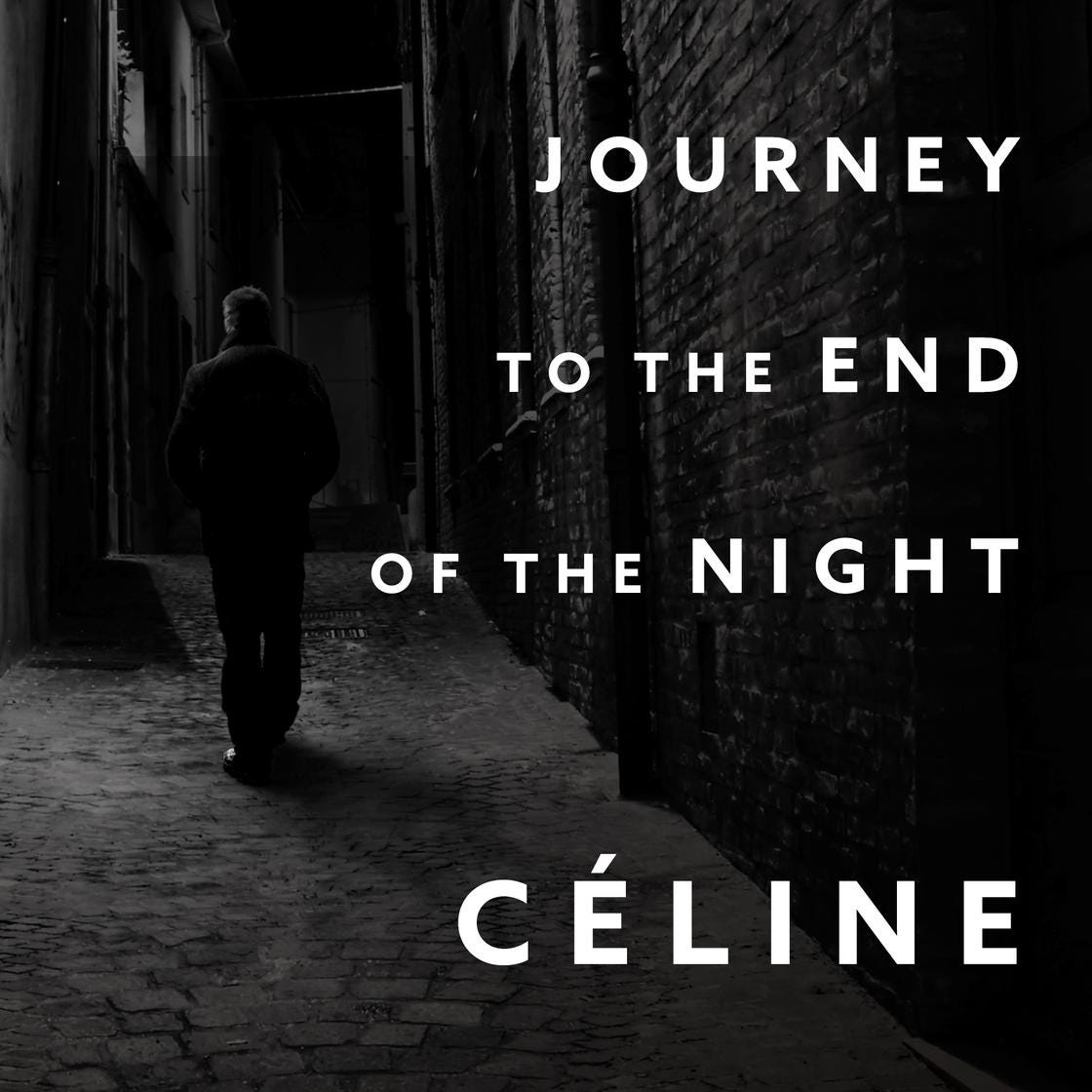
It’d always been one of those books I meant to cross off my list but I never had. It’s title alone is intriguing, and upon first glance in my early 20s gave me the idea that maybe Céline was a surrealist, judging by the multitude of ways the idea of moving through night to find its end might serve to be.
Having read several other Céline novels—the highlight of which was Normance, which established the style I more regularly associate with its author, consisting of endless ellipses punctuating staccato bursts of highly editorial description of war and wartime—I think I still held out hope that my early idea of the interior shape of the novel would prove to meet the positive prejudice about, particularly in that it’s considering its regularly considered his masterpiece.
Furthermore, I didn’t feel bothered before by the negative connotations about reading him in the first place—I’m not someone who needs papers on an artist to insure against their worst behaviors, nor am I one to imagine I can’t learn something from a wicked or insane person—but given the abundance of evidence to the contrary—that in fact sometimes lying being the outward perception of wickedness or insanity is a truly wicked and or insane person, motivated by their own pain to take out whatever shame they can on the world while everyone’s watching—now that we’re all being watched.
On the page his style is intoxicating, almost infecting. Fun to imagine the mind behind the protagonist, unhinged at last and allowed to speak back against all the ills of his life of which there are many. I suppose if your definition of autofiction is just fictionalizing your life with far-reaching abstractions assumed then Céline is an early 20th century autofictionist of the end of WW1 and how wartime experience became transported via living bodies into social scenes, a grand guignol and a half compared to the chode bro loser code that’s exposed enough already that anybody can see how pathetic and desperate it all is, despite the vibes.
Céline is particularly hated for his blatant antisemitism of course, the depths of which we’ve hardly seen in print. I thought I understood the line between art and murder before I was shown an edition of one of the salty Frenchman’s deeper cuts, where the racial and sexual obscenity common in even his major label works looks like practice—seriously just virulent spews of reasons Jews and Blacks should be killed, etc.
But after listening to The Odyssey and The Iliad back to back near the end of last year, and while in the midst of writing an expansive description of war in the novel I’m currently writing, I felt ready to ride with a bastard and see what he had. I already knew I was never going to pick it up and read it in print—which I vastly prefer to audio reading especially with authors of style like his, to the point that it doesn’t even feel like I’ve read books when I take them that way, but that’s another story. The upside of audiobooks is at least if you’re bored you have something else you’re already doing.
Turns out I’d end up being bored far more often than I expected with the maestro’s debut work. Unlike his more out there objects, this one is told in straight sentences, where suddenly the intensity and immensity of what I’d previously experience with him stood aside and let what he was actually getting at emerge.
At first, though, for what I’d say might be the first 1/5 of the novel off my head, my expectations seemed ready to be rapidly eclipsed. Céline’s first person description of his experience fighting for France against Germany is extremely aggressive, ripe with heavy but articulate descriptions of surroundings that tend to stripe him as a pessimist, despite the necessity of his subject matter. This isn’t a comedy—most of their military pursuits are obscene at best and a gorehole at worst. Soldiers wander in the night not sure what they should hope will appear. Everyone is beyond the end of Apocalypse Now, essentially, and mean about it even when wounded.
From those pages alone, as a war document, it rivals the decadence of Guyotat while maintaining a storyline that feels as if you can feel it pressing upon you, much like the magical night I imagined as a child, but in a bad way.
Listening to all this while running along the paths around Baltimore Harbor, next to a bay where British soldiers once arrived fresh from burning down D.C., more aware than ever of the depths of the waters and what might lie underneath them; how weird it is to think of people hundreds of years ago standing in the same place looking over the same waters, knowing much different things, feeling the same, I felt its essence, gritting my teeth as the glint of truth in the descriptions of torture and pillaging, the resignation of the narrator to what might be death at any second, without a country.
After that, the slope turned downhill. For what feels like the vast majority of the next several hundred pages, we follow Bardamu back to France, and then eventually America, throughout which most of his time is spent lusting after various women. As someone who is in no way a prude when it comes to vulgarity and obscenity in art, especially fiction, I found myself slowly differentiating from the narrator and how I’d followed him as a kind of tour guide into what I imagined must Dante’s Hell ahead, as a general tendency toward douche replaced the heroism required of him to have survived to see the other side of its previous build.
What felt like hours of this shit is basically Bardamu describing what he likes about the prostitutes he hires in both countries. Which might sound fine for fans of the Bukowski-core, or even just people who’d show up to press back against the ‘there shouldn’t be sex in movies’ crowd, and might even be fine if we weren’t just constantly coming back to same complaints. That people are shit and disgusting, not worth the skin they’re stuck in, sick when rich and pathetic when poor, and so on and so forth to the Nth degree; again, all shit that I can get down with, but when presented in excess alongside an already slovenly attempt at establishing any such intrigue as an infinity or space-time.
His descriptions are colorful, even often hilarious for their ribald mix of slang and indecency, which is precisely what made him a pariah for all the wrong reasons out of the gate. His subject matter is degraded by default, whirlpools of swill in which he swims to find a reason to still exist given the high cost of everything and his penchant for self-abuse. Clearly there’s a simulation of the experience of disillusion leftover after mass destruction, but even that feels precious given the far more conventional tone Céline appropriates as a means to make his coming of age story feels like dirty old goated, at least in comparison to the excesses ahead.
This is no science fiction, certainly, and also obvious about the cultures he’s disenchanting from within at this point, almost a hundred years in the future. But yet also—kind of lame? A bit pulling its own strings too much, caught up on its own trip while manhandling anything more than rank familiarity to connect the dots. Get on with it, I found myself grumbling; OK you like to fuck, now what? OK the air literally smells like shit everywhere you are—get in line!
Mixed in liberally among his musings about various scenes and employments he takes part in on his recovery from enlistment, are what I’d call very wise bon mots. What Céline can do well is hammer through the layers of his own antagonism into sharp-edged gems that pay off with multipliers for all you’ve suffered in his shoes.
I found myself trying desperately to remember lines that struck home so well about people and movements happening now, only to feel them flutter away from me and become replaced by the next sentence, which turns out to be the nice thing about reading and running—you’re live in the moment; if it’s good, the narration might even seem to inform on your own view, like some kind of analog jailbroken Google glasses hacked into contested classic literature.
Not all augmented experiences render the same. I have to admit, during a particularly dirty section where Bardamu and a coworker are dropping N-bombs left and right, using a character’s voice to air out ignorances I’d seen offered in earnest by the same author elsewhere, I felt disturbed, running past people of color in the majority Black city where I live, I saw the writing on the wall in a different way than I might if I were reading it behind closed doors. Call it a guilt, but also it’s a reference point, both true as it can be on the page by the means that it had, and heavy to carry in one’s heart while carrying forth despite the odds against us all.
Which must be why so many would prefer not to listen. It’s certainly not for everyone, but why should making any narrative out of the blood and ass and abuse and disease that girds our dailies ever be?
Eventually, however, even I, who am happy to receive my beatings via art, found myself tuning out more and more as the novel went on. Rather than giving up whole cloth, I kept on with it, accepting the decadence itself as the subject at hand, but also adjusting the speed of playblack gradually from 1.0 to 1.3 then 1.5.
Rather than intrigued by some pulsating center established in my imagination years ago, I found myself being pushed out of the conversation, hardly even interested in learning what else happened to Bardamu or which pussy he preferred among his history of young women, or what he thought about almost anything.
I didn’t even want him to do well anymore, which perhaps helps underline the argument for necessity of all speech, even speech we don’t like; eventually, we all get tired of hearing everybody talk, and we just want to hear silence, or sometimes a song.
I started liking the book again thinking about the actual end of the night being the end of the novel, so that I could emerge back into another book that might wash out my brain with soap—not for being dirty for having read it, but for wanting some other kind of gasoline.
Instead of preoccupying myself with my own defeated expectations, I found kernels that bridged out of the morass in earnest for their ingenuity—a particularly draping, as for the Nth time, of a bloody bit of syllable across an unholy firmament, or an aside about how shittily a certain sort of rich bitch reads the world. It is what it is because it is.
And now I know. The nice thing about reading things when they are over is that they no longer hold you in the thrall of what you wished they might have been. Some people call that wasted time, but to me it’s a renewed opportunity, the exact kind of matchstrike that cause a personal revolution overnight. In the same breath, the blackened monologues would prefer to drag you down with them, laughing in your face with rotten breath while you figure out what to be offended by next. If there’s any way to commemorate a war, I’d rather find myself wanting to shoot the messenger before I’d let them tuck me into bed at night. I’m grateful it exist, and hateful it has to.
All that said, I don’t think I’ll need to read anymore Céline after this. I don’t need a hard copy of it on my self so I can reference it later; for me, his style has been metabolized, and I can see with my own two eyes.
I have this and have always wondered if it’s worth it. I have to admit… I still don’t know. This, however, was a delight to read. Nice work!
It was a long long time since I read it, though I remember it being thrilling - largely on a stylistic level. Tho I know it's nothing like the later books, which probably influenced me more.